



In actual production, selecting a kneading machine requires consideration of material characteristics, process requirements, and production capacity planning. Choosing the right equipment can significantly improve production efficiency and reduce energy consumption and labor costs. Choosing the wrong equipment can lead to uneven mixing, unstable products, and even accelerated equipment wear and tear. This article will introduce several core factors to consider when selecting a kneader, based on practical applications.
1. Material Characteristics
Material characteristics are the primary factor determining equipment selection. Different materials vary greatly in viscosity, density, flowability, and whether they are corrosive or volatile. For example, high-viscosity or highly filled materials require equipment with higher torque; volatile or gaseous materials require vacuum capability; and temperature-sensitive materials require precise temperature control. It can be said that the material properties directly determine the structural configuration and performance requirements of the kneader, making it the most critical step in the entire selection process.
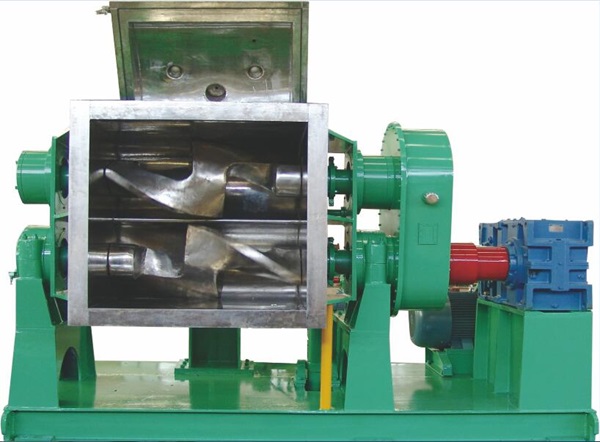
2. Matching Production Capacity with Equipment Capacity
Many users focus solely on the “volume” of equipment during selection, neglecting actual production cycle time and process time. A more reasonable approach is to calculate the required equipment capacity by considering daily output, batch time, and process flow. For example, small-scale or experimental phases may allow for smaller equipment, while large-scale production requires medium to large-scale equipment, or even multiple units operating in parallel. Choosing a capacity that is too large leads to energy waste; choosing one that is too small limits future expansion.
3. Temperature Control Method
During the kneading process, temperature directly affects the reaction effect and final quality of the materials. Common heating methods include electric heating, steam heating, and thermal oil heating. Different heating methods vary in control precision and operating costs. For industries with high-temperature requirements, such as composite materials, sealants, or polymers, it is recommended to prioritize solutions with stronger temperature-control stability to ensure product consistency.
4. Discharge Method
The discharge structure directly affects production efficiency and ease of operation. Common discharge methods include hydraulic tilting, bottom discharge, and screw extrusion. For intermittent production, tipping discharge is more common; while for continuous production or processes that require linkage with downstream equipment, screw extrusion is more suitable.
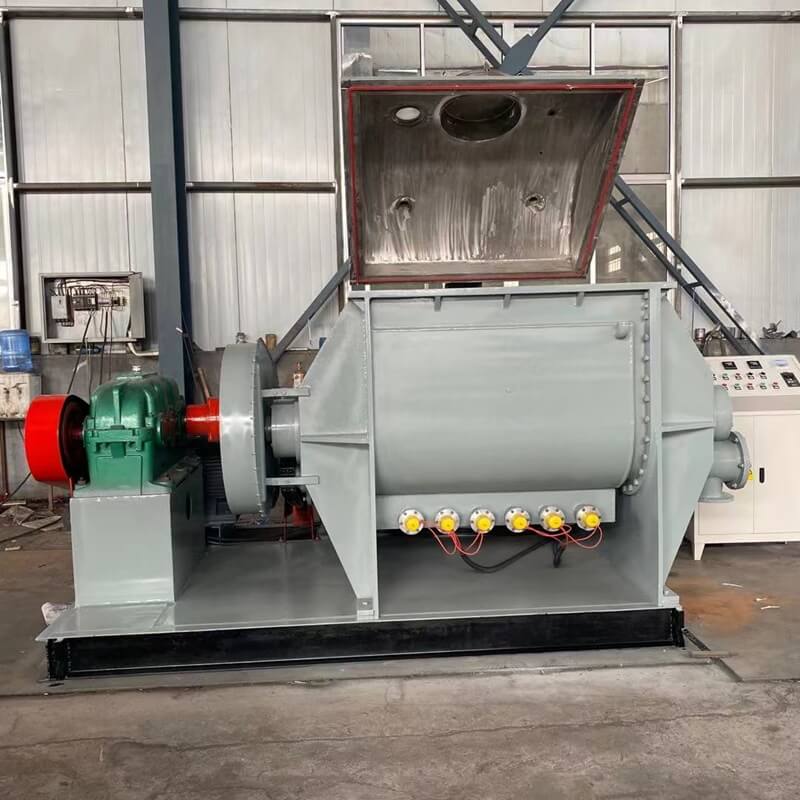
5. Automation Level of Kneading Machines
With the development of intelligent manufacturing, more and more companies are choosing equipment with PLC control, variable frequency speed regulation, automatic cylinder tilting, and temperature control systems. This not only improves production stability but also significantly reduces manual intervention and increases overall efficiency.
6. Kneading Machine Compatibility and Long-Term Operating Costs
Finally, the kneading machine‘s compatibility and long-term operating costs need careful consideration. This includes whether the kneading machine is compatible with existing production lines, the ease of maintenance, energy consumption levels, and the supplier’s technical support capabilities. Many companies focus only on the price of the equipment when purchasing, neglecting the long-term operating costs, ultimately resulting in a higher overall investment. Therefore, a comprehensive evaluation from a long-term perspective is often more important than simply comparing prices.
Overall, choosing the right kneader is essentially a process of “making decisions based on the process.” Only by fully understanding your materials and production needs and comprehensively considering multiple dimensions, such as material characteristics, capacity planning, temperature control methods, discharge structure, and automation level, can you truly select a high-efficiency, stable machine that suits your development.
If you are not familiar with the specific process, no problem, you can contact our sales representative. They will provide you with suitable solutions.
Post time: Mar-31-2026