



As a core component of individual protective equipment, the selection of molds for ballistic helmets directly determines their protective performance, weight, and wearer comfort. Unlike standard industrial molds, ballistic helmet molds involve high-performance composite materials—such as aramid fiber (Kevlar) and ultra-high molecular weight polyethylene (UHMWPE)—imposing rigorous requirements regarding mold materials, structural design, and process compatibility.
This article provides a systematic analysis of the scientific methods for selecting ballistic helmet molds, covering aspects such as material systems, molding processes, mold structures, and supplier evaluation.
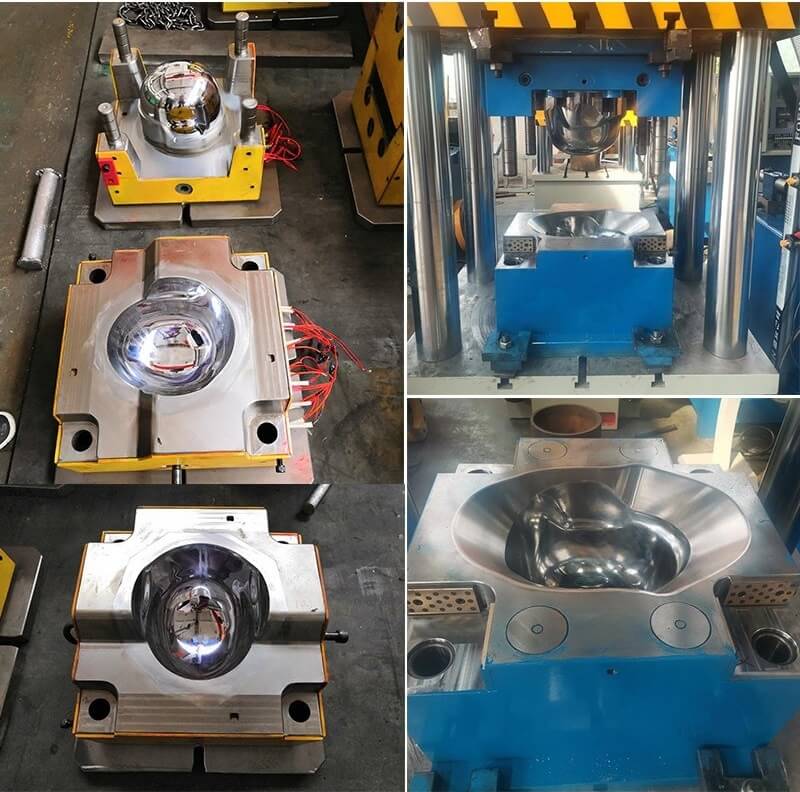
1. Clarification of Material Systems and Molding Processes for Ballistic Helmets
1.1 Comparison of Properties of Mainstream Reinforcement Materials
The protective performance of ballistic helmets depends primarily on the choice of reinforcing fiber materials, and different materials impose significantly different requirements on the molds:
|
Material Type |
Mechanical Properties |
Mold Adaptation Key Points |
|
Aramid fiber (Kevlar/Twaron) |
Strength is 5–6 times that of steel wire. Modulus is 2–3 times that of steel wire; exhibits excellent toughness and does not decompose at 560°C. |
Requires high-temperature molds (approx. 170°C). Primarily compression molding; molds must support staged pressurization. |
|
Ultra-high molecular weight polyethylene (UHMWPE/PE) |
Molecular weight of 1–5 million; superior impact resistance; extremely low fluidity. |
Compatible only with compression molding. Molds must enable staged pressurization and heating/cooling cycling. |
|
Carbon fiber |
Extremely high rigidity and strength, though elongation at break is low and energy absorption efficiency is limited. |
Often used in combination with other fibers. Molds must accommodate multi-layer composite materials. |
|
Hybrid fiber |
Combines the advantages of various materials to enhance ballistic protection capabilities. |
Molds must accommodate the specific layup and pressurization requirements of different fiber layers. |
Aramid fibers and UHMWPE are currently the mainstream materials for ballistic helmets. Aramid helmets offer excellent weight reduction but are prone to degradation upon exposure to ultraviolet light. UHMWPE helmets provide superior impact resistance but are difficult to process.
1.2 Matching Molding Processes with Mold Types
The molding process for ballistic helmets directly determines the design approach for the molds. Currently, there are four primary technical approaches:
|
Molding Processes |
Product Features |
Production Efficiency |
Cost Investment |
Mold Requirements |
|
Hand Lay-up |
Non-uniform mechanical properties; poor stability. |
Lowest |
Simple equipment, high labor costs |
Low mold cost, easy maintenance, suitable for small-batch production. |
|
Resin Transfer Molding (RTM) |
Uniform resin distribution; low porosity; excellent mechanical properties. |
Higher |
Moderate |
Requires a closed mold; complex injection port design; requires integration with a vacuum system. |
|
Compression Molding |
High molding precision; dimensional stability; good consistency. |
Suitable for mass production |
Relatively high |
Requires high-temperature, high-pressure molds used with hydraulic presses; high rigidity requirements for the mold. |
|
Net-shape Molding |
High green body strength; good uniformity. |
Higher |
Relatively high |
Extremely strict requirements for mold precision and process parameter control. |
Selection Recommendations: Hot compression molding dies are the preferred choice for high-volume, standardized production. RTM molds may be considered for small-to-medium batch sizes or customized requirements. Hand lay-up molds are suitable for small-batch trial production or prototype development.
2. Key Points on Mold Material and Structural Design
2.1 Mold Steel Selection
Bulletproof helmet molds typically operate in high-temperature environments (125°C–170°C) and must withstand high pressure. Therefore, the mold material requires the following properties:
• High-temperature strength and rigidity: To ensure no deformation under high heat and pressure;
• Excellent polishability: To guarantee helmet surface quality and minimize post-processing;
• Wear and corrosion resistance: To extend the mold’s service life.
Commonly used materials include pre-hardened steels such as P20, 718, and 738. For high-volume military orders, the use of 718 or 738 pre-hardened steel is recommended, combined with hard chrome plating or PVD surface treatment to enhance wear resistance and demolding performance.
2.2 Key Structural Design
(1) Segmented Pressurization and Temperature Control System
The core technical challenge in ballistic helmet mold design lies in achieving segmented pressurization and the transition between heating and cooling phases. Taking a UHMWPE helmet mold as an example, the mold must facilitate the following:
• Segmented pressurization: Ensuring uniform pressure distribution across all helmet sections (crown, sidewalls, and rim).
• Heating phase: Heating the mold to a set temperature to ensure full plasticization of the material.
• Cooling transition: Switching to a cooling mode during the final stage of molding to ensure the product cools and sets to the required temperature and hardness, facilitating demolding.
(2) Material-Clamping Pins and Edge-Securing Structure
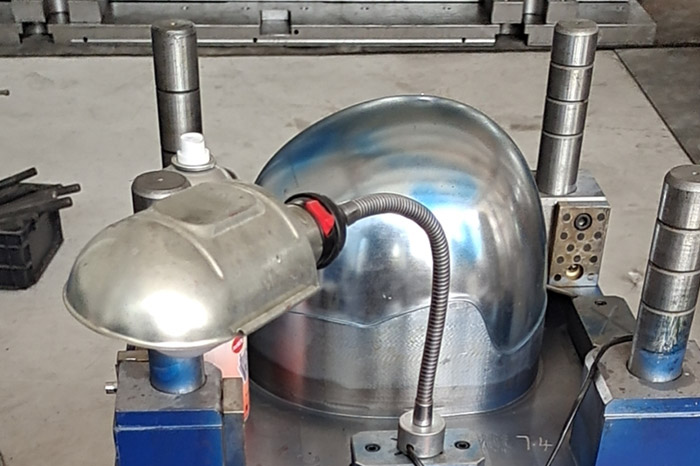
To address the issue of slippage involving flexible composite materials (such as aramid fabric laminates) during mold closure, advanced ballistic helmet molds utilize a material-clamping pin structure.
Evenly spaced through-holes are arranged around the lower edge of the mold core. Springs and clamping pins are installed within these holes, with the pins protruding a specific distance beyond the core surface.
During mold closure, the edges of the flexible laminate material are first clamped and secured between the clamping pins and the edge of the mold cavity. This eliminates material shifting and wrinkling defects caused by friction.
This design ensures consistent interlaminar pressure on the flexible laminate material during mold closure, resulting in a dense, structurally sound preform with uniform thickness and stable performance across all parts of the helmet.
(3) Modular Core Design
With a traditional integrated core, the UD (unidirectional fabric) layers at the helmet crown are compressed before those at the sidewalls during mold closing, resulting in unsynchronized pressurization. The improved design utilizes a modular core.
The core consists of a support platform, a crown section, and sidewall sections. The crown section is connected via elastic supports, positioning it higher than the sidewalls under gravity.
During mold closing, the material at the crown remains under constant compression. This ensures synchronized pressurization of both the crown and sidewall areas.
(4) Venting and Vacuum Systems
For RTM molds, particular attention must be paid to the design of injection ports and venting structures:
• Optimize the injection strategy using numerical simulation (e.g., Moldflow).
• Determine appropriate locations and quantities for injection ports to ensure uniform resin flow.
• Integrate a vacuum system to evacuate gases and minimize porosity.
3. Coordination Between Molds and Molding Equipment
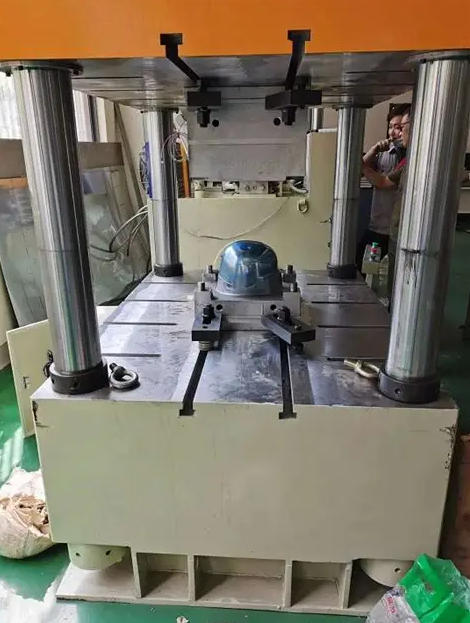
3.1 Matching Hydraulic Press Tonnage and Bed Size
Ballistic helmet molds must be used in conjunction with specialized hydraulic presses; the following factors should be considered during equipment selection:
• Tonnage requirements: Ballistic helmet molds typically require a hydraulic press with a capacity of over 500 tons; large molds or thick-walled products may require over 1,000 tons.
• Bed dimensions: Ensure sufficient space for mold installation; molds can reach lengths of 6 meters, widths of 3.8 meters, and weights of 130 tons.
• Temperature control precision: The press must be paired with a mold temperature control unit to achieve temperature precision within ±2°C.
3.2 Auxiliary Equipment Requirements
Professional ballistic helmet mold suppliers are typically equipped with:
• Large-scale hydraulic presses: Such as 5,000-ton presses, capable of handling mold trials and production for large molds.
• Vacuum equipment: To meet the requirements of vacuum molding systems.
• Heating equipment: To meet the needs for high-temperature mold heating.
• CNC machining centers: To ensure mold machining precision.
• Electrical Discharge Machines (EDM): For machining complex mold cavities.
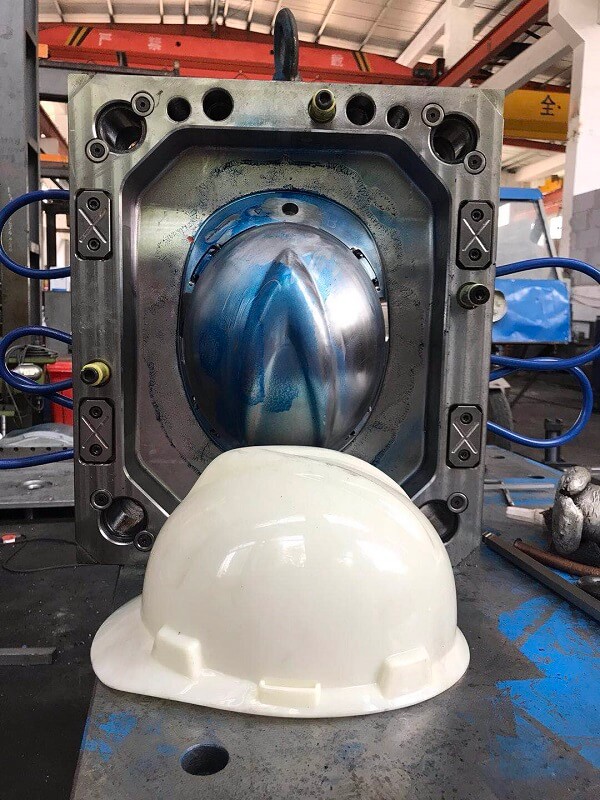
Selecting a mold for ballistic helmets is a systematic undertaking that integrates materials science, structural mechanics, and precision manufacturing. Unlike standard SMC molds, ballistic helmet molds must ensure uniform pressure application and precise temperature control for flexible composite materials under high-temperature, high-pressure conditions. The primary technical challenges lie in managing material slippage, wrinkling, and non-synchronized pressurization during the mold-closing process.
When selecting a mold, enterprises should first clearly define the product’s protection level, material system, and production volume requirements, then choose a molding process and mold structure that align with these specifications. Priority should be given to suppliers with experience in military-grade projects, CAE analysis capabilities, and comprehensive mold-testing facilities to ensure full control over the process from design to delivery.
Only by precisely matching the mold’s technical parameters with the specific processing requirements of ballistic helmets can manufacturers achieve product lightweighting and high production consistency while maintaining optimal ballistic protection. Technofrp offers high-quality ballistic helmet molds. Please contact us if you have any requirements.
Post time: Aug-19-2026